
Sugar Ants vs. Carpenter Ants: One Is a Nuisance, One Eats Your House
An ant is an ant, right up until it isn't. In Overland Park homes, the difference between the tiny ants trailing across your counter and the large black ants coming out of a window frame is the difference between an annoyance and structural damage accumulating inside your walls. Both get treated as "ants" and sprayed the same way, and that is how carpenter ant problems go unnoticed for years.
Start With Size
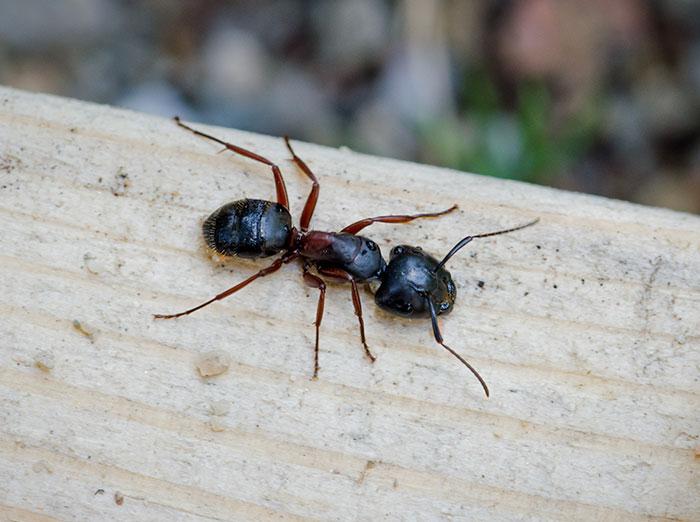
Size alone resolves most cases. Sugar ants — the common household ants people find in kitchens — are small, generally around an eighth of an inch, and often light to dark brown or black. Carpenter ants are among the largest ants you will encounter indoors, commonly a quarter to a half inch, and usually black or black with reddish coloring. If the ant is big enough that you notice it from across the room, you are likely looking at a carpenter ant.
Then Look at the Shape
If size leaves you unsure, the profile settles it. Carpenter ants have a distinctly rounded, evenly curved thorax when viewed from the side, and a single node at the waist. Many nuisance household ants have an uneven or segmented thorax profile. Carpenter ants also have a heart-shaped head and noticeably elbowed antennae, visible with a phone camera zoom.
The Real Difference: What They Do
This is what actually matters. Sugar ants are after food. They forage for sweets, grease, and water, follow scent trails to whatever they find, and nest in wall voids, under slabs, or outdoors in landscaping. They contaminate food and are genuinely frustrating, but they do not damage the structure of your home.
Carpenter ants are after shelter, and they get it by excavating wood. They do not eat wood the way termites do — they chew through it to hollow out smooth galleries for nesting and discard the debris. Over time, that excavation weakens framing, joists, window and door frames, sill plates, and decking. A well-established colony working on structural wood is a repair bill, not a nuisance.
What Each One Leaves Behind
The evidence differs as much as the behavior:
- Sugar ants: visible trails along counters, baseboards, and walls leading to a food or water source; clusters around spills, pet bowls, sinks, and trash.
- Carpenter ants: frass — a sawdust-like pile of wood shavings mixed with insect parts — beneath small openings in wood. This is the single most reliable sign and is often mistaken for ordinary sawdust.
- Carpenter ants: smooth, clean galleries inside wood, with no mud in them. Tapping the wood may produce a hollow sound.
- Carpenter ants: faint rustling or crackling sounds inside walls at night, when the colony is most active.
- Carpenter ants: winged swarmers appearing indoors, usually in spring — a serious sign discussed below.
Where Each One Nests
Sugar ants nest wherever it is convenient — soil and mulch beds outdoors, wall voids, beneath slabs, under insulation. Moisture helps but is not required.
Carpenter ants are moisture-driven, and this is a useful diagnostic. They strongly prefer wood that has been softened by water. In Overland Park homes that means areas around leaking roofs and gutters, poorly flashed chimneys, bathroom and kitchen plumbing leaks, damp crawl spaces, window and door frames exposed to weather, deck posts in contact with soil, and tree stumps or firewood near the house. Finding carpenter ants indoors is usually also finding a moisture problem you did not know you had.
Why the Distinction Changes the Treatment
Treating carpenter ants like sugar ants is the expensive mistake. Wiping out a trail of foragers accomplishes little against a colony nesting in a wall — and worse, it removes the visible evidence that would have told you something was wrong. Homeowners spray, the ants disappear from view, and the excavation continues quietly for another season.
Carpenter ant control requires locating the nest and any satellite nests, treating the colony directly, and correcting the moisture that made the wood attractive in the first place. Skip the moisture correction and a new colony finds the same softened wood. Sugar ant control, by contrast, focuses on baiting and non-repellent treatments that collapse the colony, plus sanitation and sealing entry points.
One Sign You Should Never Ignore
If you see large winged ants indoors, especially in spring, take it seriously. Carpenter ant colonies only produce winged reproductives once they are mature, and swarmers emerging inside the house mean the nest is inside the structure — not out in the yard. That is a call-today situation rather than a watch-and-wait one.
The Third Possibility: Termites
Winged insects indoors could also be termite swarmers, which look superficially similar and cause far more damage. Termites have straight antennae, a thick waist with no pinch, and two pairs of wings of equal length; ants have elbowed antennae, a pinched waist, and forewings longer than hindwings. Termite galleries are packed with mud and soil; carpenter ant galleries are smooth and clean. If you are not certain which you are looking at, an inspection is worth the trip.
What to Do Next
If the ants are tiny and trailing to food, you have a nuisance problem — manage sanitation, seal entry points, and use properly matched baits rather than sprays. If the ants are large and black, if you find frass, if you hear rustling in a wall, or if winged ants appear indoors, treat it as a structural issue and get the wood inspected. Frontier Trapper identifies the species, locates the nest, treats the colony, and addresses the moisture conditions behind it — because with carpenter ants, removing the ants without fixing the water only buys you time.