


Trails of Tiny Ants on Your Counter? Here's What They're Really Telling You
A thin, moving line of tiny ants marching across your kitchen counter, along the baseboard, or around the sink is one of the most common calls we get from Overland Park homeowners. Those little sweet-loving ants — what most people call sugar ants — have found a reliable food or water source in your home and laid down a scent trail so the rest of the colony can follow it straight to the reward. The ants you can see are only a fraction of the story: the visible trail is a supply line, and the colony feeding it is tucked away in a wall void, under a slab, or out in the landscaping where you'll never spot it.
That's why the instinct to grab a spray bottle and wipe out the trail usually backfires. Killing foragers does nothing to the queen or the brood, and with some of our local species it can actually make the problem worse. Lasting sugar ant control comes from getting the colony to poison itself through targeted baiting, then removing the food, moisture, and entry points that invited them in. Frontier Trapper takes that source-first approach. Below is how to tell which ant you actually have, why they're in your Overland Park home, what control costs in our area, and how we get rid of them for good.
What Are Sugar Ants? (Which Ant Do You Actually Have?)
"Sugar ant" isn't a single species — it's a catch-all name for the small, sweet-feeding household ants that show up indoors hunting for sugars, grease, and water. Getting the identification right matters, because the right bait and the right strategy depend on the species. In Overland Park and Johnson County, three ants account for the vast majority of what people call sugar ants.
Odorous House Ants
By far the most common sugar ant in our area, the odorous house ant is a small, dark brown to black ant about 1/16 to 1/8 inch long. Its signature is the smell: crush one and it gives off an unpleasant, rotten-coconut or blue-cheese odor. These ants love sweets, nest in an enormous range of spots — wall voids, under floors, beneath rocks, mulch, and slabs — and form very large colonies with multiple queens. That last detail is critical: disturbing or spraying an odorous house ant trail can trigger "budding," where the colony splits into several new nests to survive, leaving you with more problems than you started with.
Pavement Ants
Pavement ants are small, dark brown to blackish ants that, as the name suggests, nest under sidewalks, driveways, slabs, and along foundations, pushing up little piles of displaced soil at cracks and expansion joints. They'll forage indoors for both sweets and greasy, protein-rich foods, following the same trailing behavior. They're a frequent kitchen and basement visitor in Overland Park homes built on slabs, and they respond well to baiting when the bait is matched to what they're currently craving.
Acrobat Ants
Acrobat ants get their name from a habit: when disturbed, they raise their heart-shaped abdomen up over their body like an acrobat. They're small and range from light brown to black. Outdoors they nest in dead or moisture-damaged wood, and indoors they'll follow utility lines and settle into damp wall voids or foam insulation. Because they favor water-damaged wood, acrobat ants indoors can be a clue that there's a hidden moisture or leak issue worth finding.
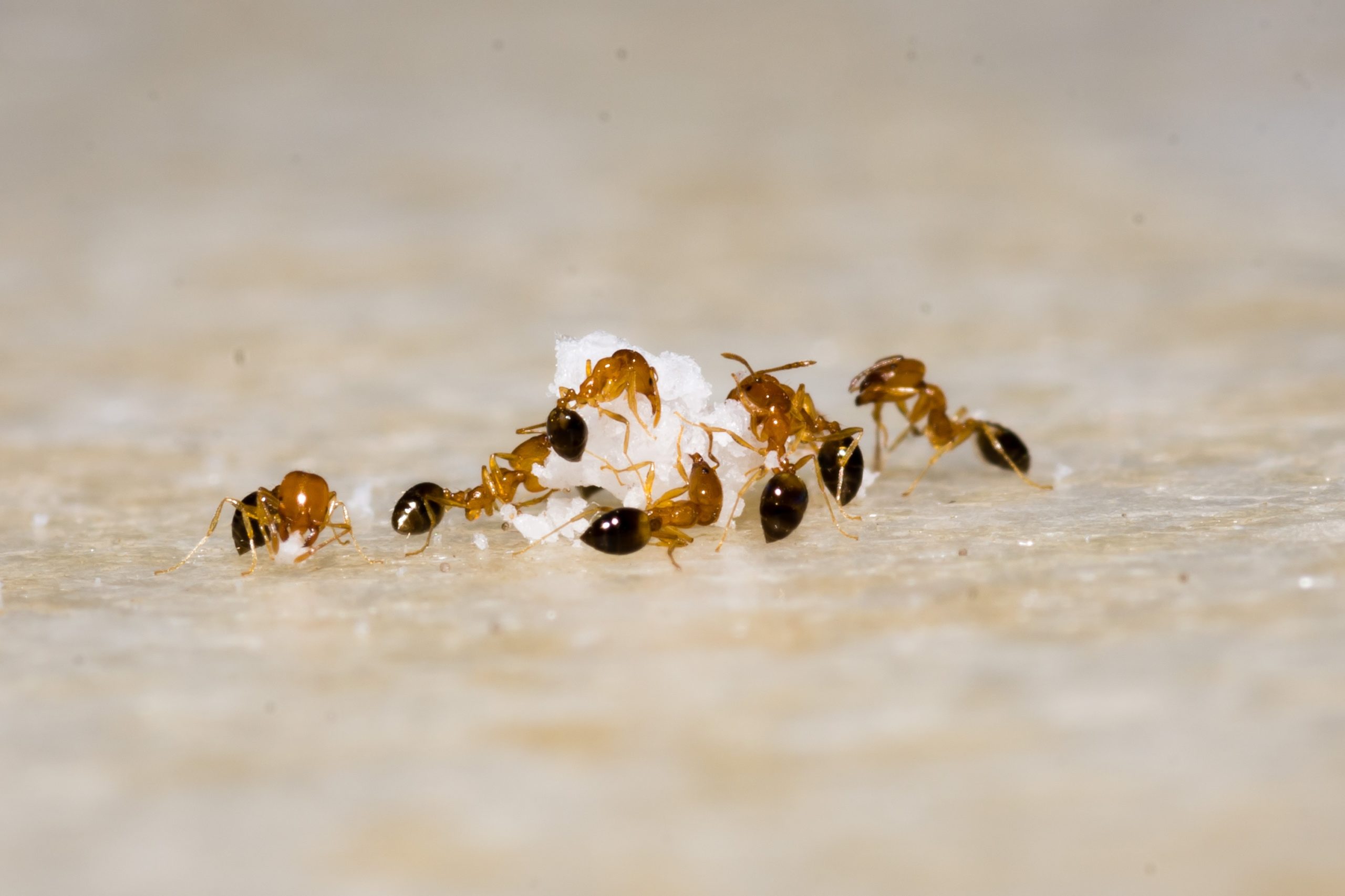
Three Ants, One Nickname
Why Overland Park Homes Get Sugar Ants
Sugar ants are constantly scouting for food and water, and Overland Park homes offer plenty of both. When you spot a trail, it means a scout found something worth reporting back to the colony. These are the conditions that draw them in and keep them coming:
Signs of a Sugar Ant Problem
A single wandering ant now and then is normal. A defined trail, ants returning to the same spot day after day, or ants appearing in multiple rooms means a colony has established a supply line into your home and is actively foraging.
Are Sugar Ants Dangerous?
For the most part, sugar ants are a nuisance rather than a genuine health or safety threat. They don't sting like fire ants, they don't spread serious disease, and — unlike carpenter ants — they don't tunnel through and structurally damage your home's wood. The real problem is contamination and volume: they crawl across counters, into open food, and around dishes, which is unsanitary, and a large odorous house ant colony can put thousands of foragers through your kitchen. Acrobat ants indoors carry one extra caution — because they favor moisture-damaged wood, their presence can point to a hidden leak that needs attention. But in the vast majority of cases, sugar ants are an unwelcome, unsanitary intrusion, not a danger to your family.
How Sugar Ants Get Into Your Home
Because they're so small, sugar ants exploit gaps most people never notice, and they often follow moisture and utility lines straight into the living space:
Because entry points are small and often tied to moisture or landscaping, sealing gaps and correcting conditions matters far more than spraying the ants you happen to see crossing the counter.
How Much Does Sugar Ant Control Cost in Overland Park, KS?
Sugar ants are usually handled with targeted baiting and exclusion, either as a standalone visit or as part of a perimeter pest program. In the Overland Park and Johnson County market, expect costs in these general ranges:
Estimates for a typical 1,600–2,000 sq ft home; larger homes generally add 10–15%. Pricing varies with the ant species, colony size, how many entry points and nests are involved, and whether moisture issues need to be addressed.
What moves the price:
Because sugar ant control depends so much on which species you have and where the colony lives, an on-site inspection is the only way to price it accurately. Frontier Trapper inspects your home, identifies the ant and the source, and provides an estimate based on what your situation actually requires.
Our Sugar Ant Control Process
Sugar ants are a colony problem, not a countertop problem, so we treat the source rather than just the trail you see.
1. Inspection & Identification
We identify the exact species, follow the trails back toward their source, and pinpoint entry points, nesting areas, and any moisture or food conditions feeding the colony. That tells us which bait to use and where — because the wrong approach on odorous house ants can split the colony instead of eliminating it.
2. Targeted Baiting
This is the step that actually eliminates the colony. We place gel and liquid baits matched to what the ants are feeding on and let the foragers do the work: they carry the bait back to the nest and share it, through feeding, with the workers, the brood, and the queen or queens. Because we use non-repellent, slow-acting baits instead of quick-kill sprays, the ants keep trailing to the bait long enough to poison the whole colony from the inside out — which is why we deliberately avoid disrupting the trail with repellent products.
3. Sanitation & Moisture Correction
Baiting works best when your home stops competing with it. We identify the food and water sources drawing ants in — leaks under sinks, condensation, damp areas, open food, crumbs, and pet food — and lay out the sanitation and moisture fixes that remove the ants' reason to stay. Cutting off water and easy food both speeds up the current job and discourages the next colony.
4. Exclusion & Prevention
Finally, we seal the small entry points sugar ants use — foundation cracks, gaps around pipes and wires, and openings at doors and windows — and address the exterior conditions, like mulch and landscaping against the foundation, that put colonies within reach. The same exclusion work that stops sugar ants helps keep other small invaders out too.
What You Can Do Yourself
A few homeowner habits make professional baiting far more effective and discourage sugar ants from settling in:
One important caution: once bait has been placed, do not spray insecticide over it or along the trail. Spraying repels the ants and kills the foragers before they can carry the bait home, which is exactly what defeats the treatment. Let the bait do its job.
A Year-Round Sugar Ant Calendar for Overland Park
Why Choose Frontier Trapper for Sugar Ant Control?
Frontier Trapper is a locally owned, woman-owned, licensed and insured company that understands Overland Park homes and the sugar ant pressure that comes with Johnson County's wet springs and hot, dry summers. We lead with correct identification and targeted baiting rather than reflexively spraying the trail — because we know that spraying odorous house ants can split the colony and make things worse. We pair that baiting with sanitation, moisture correction, and exclusion so the colony is eliminated and the conditions that invited it are fixed. Our methods are safe for your family and pets when applied correctly, and because we treat the source instead of the symptom, the results actually last.
Get Rid of Sugar Ants in Overland Park Today
Stop wiping the same trail off your counter every morning and eliminate the colony behind it. Frontier Trapper will identify the exact ant, locate the source, and build a bait-first control plan that clears out sugar ants and keeps them from coming back. Call (816) 914-8660 or request your inspection today.
Frequently Asked Questions
Find answers to common questions about our wildlife trapping and removal services
Get a Fast Estimate to Reclaim Your Home Today!
Stop wiping the same ant trail off your counter and eliminate the colony behind it. Request your inspection today.
Call Now 816-914-8660