

Seeing Large Black Ants Indoors or Finding Sawdust Piles? Here's What It Means
Big black ants marching across your kitchen counter at night, a small pile of what looks like sawdust under a window sill, or a faint rustling behind the wall — these are the classic signs of carpenter ants, and they're telling you more than you might think. Unlike the tiny nuisance ants that raid a spilled sugar bowl, carpenter ants are a wood-destroying pest. Here's the part most homeowners get wrong: carpenter ants don't eat wood. They excavate it, chewing smooth galleries through moist or damaged lumber to build their nests. When you see them inside an Overland Park home, they're usually pointing at damp or decaying wood somewhere in the structure — and the ants you can see are only a fraction of the story.
That's why lasting carpenter ant control isn't about spraying the ants on the counter. Killing foragers does nothing to the colony hidden in the wall, the tree stump in the yard, or the water-damaged sill plate under the bathroom. Real control means locating the parent nest and its satellite nests, treating them directly, and then correcting the moisture that invited the ants in the first place. Frontier Trapper takes that source-first, exclusion-focused approach. Below is how to tell carpenter ants from termites, why they target our homes, what treatment costs in our area, and how we get rid of them for good.
What Are Carpenter Ants? (And How They Differ From Termites)
Carpenter ants are the largest ants you're likely to see indoors, and they're routinely mistaken for termites because both damage wood. But they're very different animals with different habits, and telling them apart tells you what you're actually dealing with — and how urgent it is.
Appearance
Carpenter ants are big — workers range from about a quarter inch to half an inch long, and they're often solid black, though some are dark red or a black-and-red mix. They have the classic ant shape: a narrow, pinched waist, elbowed (bent) antennae, and, when winged, a set of wings where the front pair is noticeably larger than the back. Termites, by contrast, have a straight, thick waist, straight antennae, and two pairs of wings that are equal in size and length.
Frass, Not Mud Tubes
As carpenter ants excavate their galleries, they push the debris out through small slit-like openings, leaving behind frass — a fine, sawdust-like material often mixed with insect body parts and bits of insulation. Piles of frass beneath wood are a hallmark of carpenter ants. Termites, on the other hand, build mud tubes: pencil-thick tunnels of soil and saliva running up foundations and walls. Frass means ants; mud tubes mean termites.
They Tunnel, They Don't Eat
This is the single most important distinction. Termites actually consume wood for nutrition, digesting the cellulose, which is why they can destroy a structure relatively quickly. Carpenter ants get no nutrition from wood at all — they only hollow it out to make room for the colony. Their galleries are smooth, clean, and sanded-looking, while termite galleries are rough and packed with mud and soil. Carpenter ants feed instead on other insects and on sweet, protein-rich foods they forage from your home and yard.
Swarmers
In spring, mature colonies of both pests produce winged reproductives, or swarmers, and this is when the two are most often confused. Carpenter ant swarmers have a pinched waist, bent antennae, and unequal wings. Termite swarmers have a straight waist, straight antennae, and equal wings. If you find swarmers indoors near a window, look closely at the waist and antennae — those two features settle the identification, and getting it right determines whether you need carpenter ant treatment or a full termite inspection.
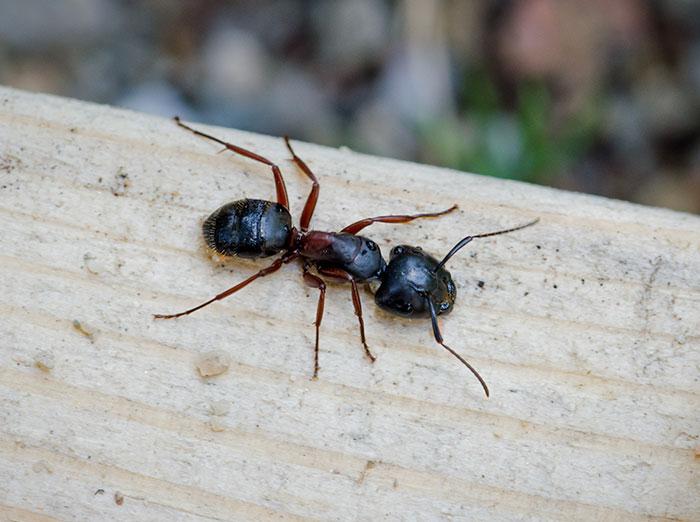
Carpenter Ant vs. Termite: Know What You Have
Why Overland Park Homes Get Carpenter Ants
Carpenter ants are drawn to exactly the conditions Overland Park and Johnson County provide across the year. Because they nest in moist and damaged wood, most infestations trace back to water:
Signs of a Carpenter Ant Problem
A single large ant now and then can be a forager that wandered in from the yard. But frass, repeated nighttime sightings, rustling, or spring swarmers indoors indicate a nest — and finding that nest is what turns a temporary knockdown into real control.
Are Carpenter Ants Dangerous?
Carpenter ants are not a health threat. They don't spread disease, and while a large worker can deliver a pinching bite if handled, they aren't aggressive and pose no meaningful medical risk. The real danger is structural. As a colony matures and expands, its galleries can weaken framing, sills, joists, and trim over time. Carpenter ants work more slowly than termites — damage typically develops over years rather than months — but the harm is real and cumulative, and it's compounded by the fact that the moisture attracting the ants is often rotting the wood on its own. Left alone, a colony keeps growing and spreading satellite nests, so treating it early and fixing the underlying moisture protects your home before repairs get expensive.
How Carpenter Ants Get Into Your Home
Carpenter ants exploit the connection between the outdoors and your home's wood. Most infestations start with an outdoor parent nest, and workers reach the structure through:
How Much Does Carpenter Ant Treatment Cost in Overland Park, KS?
Carpenter ant control is priced according to how much nest-hunting and wood correction the job requires, since finding the colony is the hard part. In the Overland Park and Johnson County market, expect costs in these general ranges:
Estimates for a typical 1,600–2,000 sq ft home; larger homes generally add 10–15%. Pricing varies with how well hidden the nest is, the number of satellite colonies, and how much moisture and wood correction is involved.
What moves the price:
Because carpenter ant control depends entirely on finding the nest and the moisture feeding it, an on-site inspection is the only way to price it accurately. Frontier Trapper inspects your home, locates the colonies and the conditions sustaining them, and provides an estimate based on what your situation actually requires.
Our Carpenter Ant Control Process
Carpenter ants are a symptom of moisture and hidden nesting, so we treat the source — the colonies and the damp wood feeding them — not just the ants you see on the counter.
1. Inspection & Colony Location
We follow ant trails, tap and probe suspect wood, and inspect the damp, decay-prone areas carpenter ants prefer — sills, subfloors, window and door frames, crawl spaces, and the exterior, including trees and stumps. The goal is to pinpoint the parent nest and any satellite colonies, because treating the colony is the only thing that ends the problem.
2. Targeted Treatment & Baiting
Once we know where the colonies are, we treat them directly rather than fogging the house. We use specialized baits and non-repellent products that foragers carry back and share throughout the nest, reaching the queen and the brood. Where a nest is located in a wall void or damaged wood, we treat it at the source. This colony-focused approach is what eliminates the population instead of just scattering it — random surface spraying often splits a colony and makes control harder.
3. Moisture & Wood Correction
This is the step that makes carpenter ant control last. Because the ants nest in damp and decaying wood, we identify the moisture problems that invited them — leaks, poor drainage, condensation, and rot — and lay out practical fixes. Correcting the water source and dealing with compromised wood removes the very habitat carpenter ants need, so a treated home doesn't simply get re-colonized next season.
4. Exclusion & Prevention
Finally, we seal the pathways ants use — foundation gaps, cracks, and utility penetrations — and advise on trimming branches back from the roof and moving firewood and mulch away from the foundation. The same exclusion and moisture work that stops carpenter ants also protects against the other wood- and moisture-loving pests that share their habitat.
What You Can Do Yourself
A few homeowner habits make professional treatment far more effective and discourage carpenter ants from settling in:
A Year-Round Carpenter Ant Calendar for Overland Park
Why Choose Frontier Trapper for Carpenter Ant Control?
Frontier Trapper is a locally owned, woman-owned, licensed and insured company that understands Overland Park homes, the mature trees and older construction of our neighborhoods, and the wet springs and humid summers that keep wood damp across Johnson County. We treat carpenter ants as the wood-and-moisture problem they are, rather than just spraying the ants you see. We lead with inspection to find the parent and satellite nests, treat the colonies directly with targeted baiting, and correct the moisture and seal the entry points that let them in. Because our approach targets the source, results last — and the same exclusion and moisture work that stops carpenter ants also protects your home from the other pests that thrive in damp wood.
Get Rid of Carpenter Ants in Overland Park Today
Stop swatting large black ants on the counter and fix what's drawing them into your wood. Frontier Trapper will inspect your home, locate the colonies, pinpoint the moisture sustaining them, and build a control plan that protects your home from structural damage for good. Call (816) 914-8660 or request your inspection today.
Frequently Asked Questions
Find answers to common questions about our wildlife trapping and removal services
Get a Fast Estimate to Reclaim Your Home Today!
Stop the damage at its source. We find the nest, treat the colony, and fix the moisture. Request your inspection today.
Call Now 816-914-8660