

Venomous Snakes in Kansas: What's Actually in Johnson County
Kansas is home to roughly forty snake species, and the overwhelming majority are entirely harmless — beneficial, even, since they keep rodent populations down. Only a handful are venomous, and fewer still are realistically encountered around Overland Park. Knowing which is which turns a frightening moment in the yard into a manageable one, and keeps harmless snakes from being killed unnecessarily.
The Venomous Species in Kansas
All of Kansas's venomous snakes are pit vipers. Statewide the list includes the copperhead, the timber rattlesnake, the prairie rattlesnake, the western massasauga, and the western pygmy rattlesnake — but their ranges vary substantially. Prairie rattlesnakes are western Kansas animals and are not part of the picture in Johnson County. For the Overland Park area, the copperhead is by far the most relevant, with timber rattlesnakes possible in the region's wooded and rocky areas but far less commonly encountered.
Copperhead: The One to Know
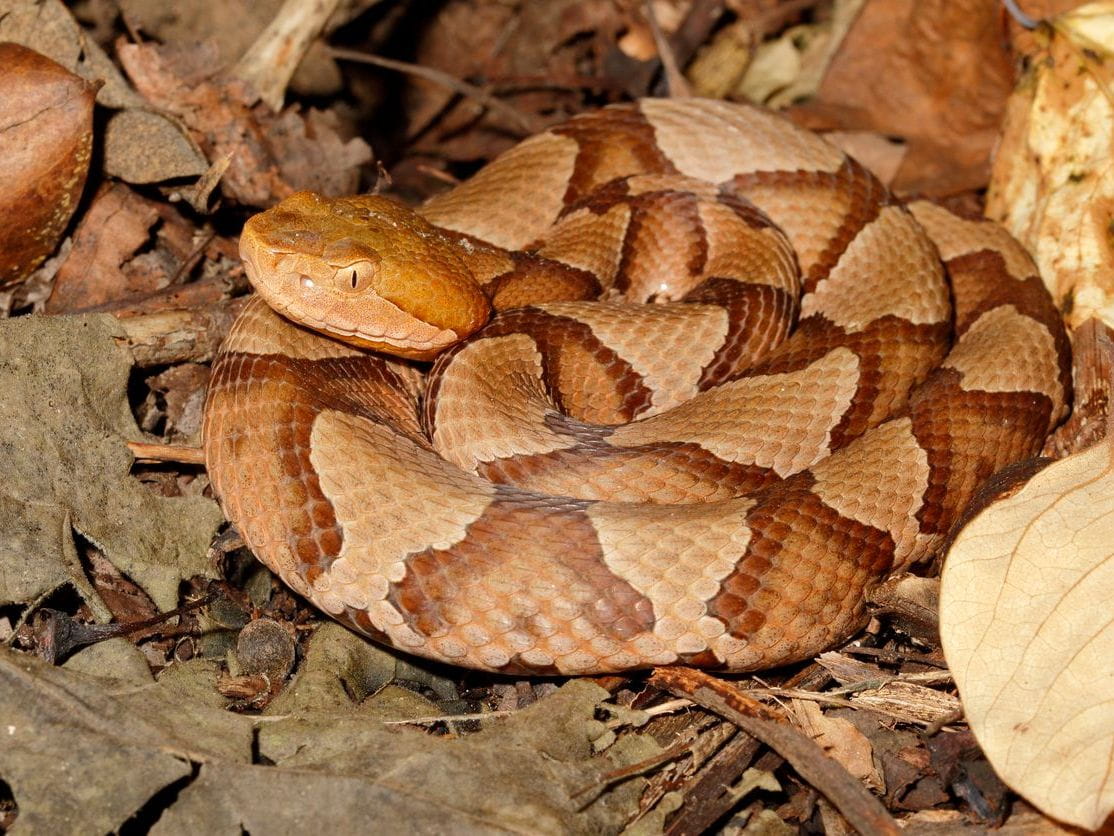
If you learn to identify one venomous snake in eastern Kansas, make it this one. Copperheads are tan to pinkish or coppery, with a pattern of dark crossbands that are wide on the sides and narrow across the spine — often described as hourglass or Hershey's Kiss shapes when viewed from above. The head is coppery to reddish-brown and noticeably broader than the neck.
They favor wooded areas, rocky hillsides, brush piles, leaf litter, stone walls, and woodpiles — and they rely almost entirely on camouflage. A copperhead lying in leaf litter is genuinely difficult to see, which is why most bites happen when someone steps on or reaches near one without knowing it, not because the snake pursued anyone. Copperhead bites are painful and require medical attention, but they are rarely life-threatening to healthy adults.
Juvenile copperheads have a bright yellow or greenish tail tip, which they use to lure prey. A small snake with a yellow-tipped tail should be treated as venomous.
Timber Rattlesnake
Larger and heavier-bodied, gray to yellowish-brown with dark chevron or V-shaped crossbands and often a rust-colored stripe down the spine, ending in a black tail with a rattle. They occur in eastern Kansas in wooded, rocky terrain but are uncommon in developed suburban areas. A rattle is definitive, though a snake may not always rattle before being noticed, and rattles can be broken or missing.
The Harmless Snakes People Mistake for Venomous
Most "venomous snake" calls in Overland Park turn out to be one of these:
- Northern water snake. Heavy-bodied, dark, banded, and aggressive-looking when cornered, and almost always misidentified as a cottonmouth. Cottonmouths are not established in the Johnson County area. Water snakes are non-venomous.
- Eastern rat snake (black rat snake). Large, dark, and often found climbing — including into attics and barns after rodents. Harmless and genuinely useful to have around.
- Bullsnake. Big, boldly blotched, and known for hissing loudly and vibrating its tail in leaf litter, which produces a convincing rattle imitation. Non-venomous.
- Prairie kingsnake and milk snake. Blotched brown or reddish patterns often mistaken for copperhead markings, but the blotches are rounded rather than hourglass-shaped.
- Garter snakes. Small, striped, extremely common in yards and gardens, and entirely harmless.
Identification Cues — and Their Limits
Several traits distinguish pit vipers from harmless snakes, but they require a close look you should not be taking:
- Head shape: pit vipers have a broad, triangular head clearly wider than the neck. Unreliable on its own, because many harmless snakes flatten their heads defensively to mimic exactly this.
- Pupils: pit vipers have vertical, cat-like pupils; most harmless species have round pupils. Accurate, but far too close a view to be practical or safe.
- Heat-sensing pit: a small opening between eye and nostril, present on pit vipers. Again, too close.
- Pattern: for copperheads specifically, crossbands wide at the sides and narrow across the spine. This is the most usable field cue at a safe distance.
- Tail: a rattle means rattlesnake, but its absence proves nothing.
The practical approach is simpler: photograph from a safe distance with your phone's zoom and let someone identify it from the image. Treat any snake you cannot confidently identify as venomous.
Found a snake you can't confidently identify? Don't risk it. Our snake removal service handles safe identification and humane removal — venomous or not.
Explore Snake Removal in Overland ParkWhat to Do If You Find One
- Back away and give it distance. Nearly all bites happen when someone tries to handle, kill, or move a snake. Left alone, snakes leave on their own.
- Keep children and pets inside and away from the area until it is resolved.
- Note where it is and watch from a distance if you can do so safely — knowing whether it went under a deck, into a woodpile, or off into brush matters for removal.
- Photograph it with zoom, not proximity.
- Do not attempt to kill it. This is when most bites occur, and a struck snake can still bite reflexively. Many of the snakes killed this way are harmless and beneficial.
- Call for professional removal if it is venomous, if you cannot identify it, or if it is inside a structure.
If Someone Is Bitten
Get to emergency medical care immediately. Keep the person calm and still, keep the bitten limb below heart level if possible, and remove rings, watches, and tight clothing before swelling begins. Do not apply a tourniquet, do not cut the wound, do not attempt to suck out venom, and do not apply ice. If it can be done safely from a distance, a photo of the snake helps treatment — but do not go back for one.
Reducing the Odds
Snakes come for shelter and food. Clear brush piles, woodpiles, tall grass, and debris that provide cover; keep grass mowed, especially near the house; store firewood off the ground and away from the structure; seal gaps in foundations, crawl space vents, and under doors; and control rodents, since a rodent problem is a standing invitation. Our snake prevention guide covers the property-level steps in more detail.
If you have a snake on your property and are not certain what it is, Frontier Trapper handles identification and safe removal across Overland Park and Johnson County — venomous or not.