

Centipede vs. Millipede: How to Tell Them Apart
People lump these two together constantly — many legs, unsettling to find, both turn up in basements. But they are entirely different animals with different diets, different behavior, and different implications for your home. One is a predator that is telling you about other insects. The other is a harmless scavenger that is telling you about the weather. Knowing which you have changes what you should do about it.
The Quickest Test: Count the Legs Per Segment
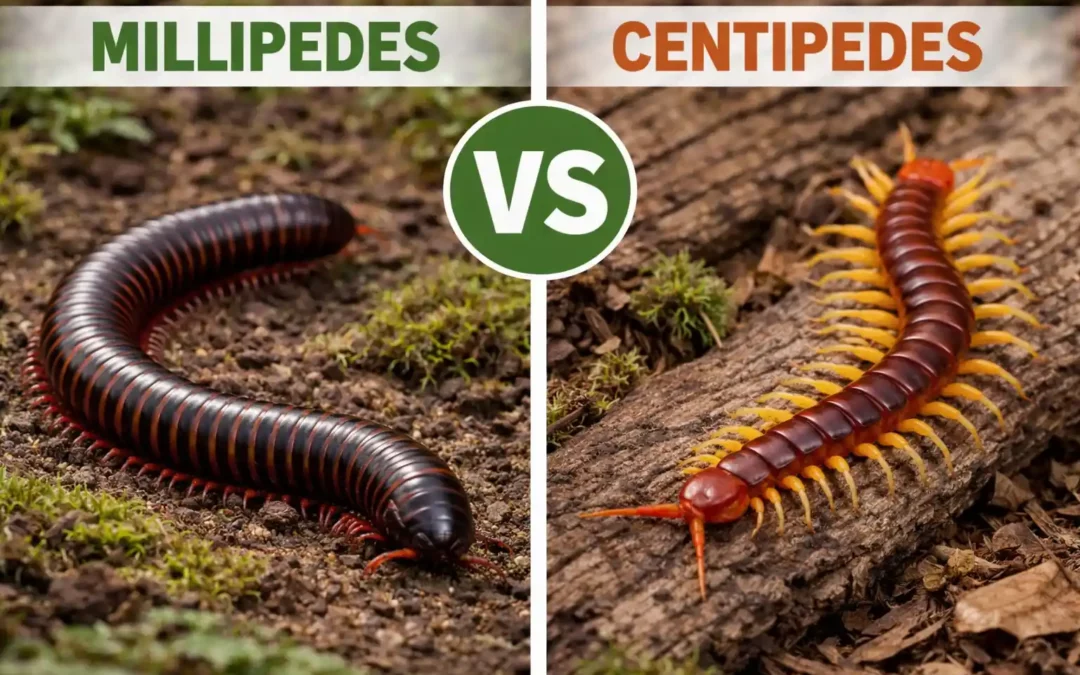
This is the definitive difference, and it is easier to see than it sounds. Centipedes have one pair of legs per body segment. Millipedes have two pairs per segment, which gives them a dense, fringe-like appearance along the body.
Neither actually has a hundred or a thousand legs, despite the names — but the ratio holds, and it is the trait that never fails.
Body Shape
Centipedes are flattened top-to-bottom, with legs projecting out to the sides. The common house centipede is grayish-yellow with long, dramatic legs and long antennae, and it looks built for speed — which it is.
Millipedes are rounded and cylindrical, like a piece of dark cord, with short legs tucked underneath rather than splayed out. They are usually brown to black and look much less dramatic.
Speed and Behavior
If it darted across the floor and vanished before you could react, it was a centipede. Centipedes are hunters and they move genuinely fast — that startling burst of speed across a basement floor or bathroom tile is the single most common way people encounter them.
Millipedes move slowly and deliberately. When disturbed, a millipede curls into a tight spiral rather than fleeing, and may emit a faintly foul-smelling defensive fluid. A centipede never curls up — it runs.
What They Eat — and Why It Matters
This is the difference with real consequences for your home.
Centipedes are predators. They hunt and eat other insects — spiders, silverfish, cockroaches, ants, and small flies — and they have venom they use to subdue prey. That means a centipede indoors is following a food supply. Finding several over the course of a week is worth reading as a signal: something is feeding them.
Millipedes are scavengers that feed on decaying plant matter — leaf litter, mulch, and damp organic debris. They have no interest in hunting and nothing to eat inside your house. They wander in by accident, usually in large numbers during weather shifts, and then die indoors because it is too dry for them.
Can They Hurt You?
A house centipede can bite if handled or trapped against skin, and the venom that makes it an effective hunter can produce a sting comparable to a bee sting. But they are not aggressive, they flee from people rather than approach, and bites are uncommon. For the most part they are harmless to humans — and arguably useful, since they eat the pests you like even less.
Millipedes cannot bite at all. The defensive fluid some species release can irritate skin or stain, and it is worth washing your hands after handling one, but they pose no real risk.
The Quick Comparison
- One pair of legs per segment, flattened body, long legs to the sides: centipede.
- Two pairs of legs per segment, rounded cylindrical body, short legs underneath: millipede.
- Fast — gone before you can react: centipede. Slow and deliberate: millipede.
- Curls into a tight spiral when disturbed: millipede. Runs: centipede.
- Hunts other insects and has venom: centipede. Eats decaying plant matter and is harmless: millipede.
- Found in ones and twos, repeatedly, over time: centipede. Found in sudden large numbers, often dead: millipede.
What Each One Is Telling You
The shared thread is moisture — both are drawn indoors by damp conditions, and much of the prevention work overlaps. But the message differs.
Centipedes mean moisture plus prey. They stay where hunting is good, so a recurring centipede presence points to an insect population you probably have not identified yet — often silverfish, small spiders, or ants in a damp basement or crawl space. Removing the centipedes without addressing that food supply leaves the reason for their visit fully intact.
Millipedes mean weather. They migrate in waves, typically after heavy rain that saturates the soil and drives them out of mulch and leaf litter, or during dry spells when they move toward moisture. It is a seasonal, weather-driven nuisance rather than an infestation, and it usually resolves on its own once conditions shift.
Why Overland Park Gets Both
Johnson County supplies what each one needs. The basements, walkout lower levels, and crawl spaces common in area homes hold summer humidity and are prone to drainage issues and water intrusion. Outside, the thick mulch beds, dense foundation plantings, and decorative stone typical of local landscaping create damp, organic harborage right against the house. Add wet, storm-heavy springs and hot dry summer stretches, and both animals get pushed toward foundations at predictable points in the year.
Finding either one regularly? Both point to moisture, and centipedes point to other insects too. Our centipede control service addresses the cause, not just the bugs you spot.
Explore Centipede Removal in Overland ParkWhat to Do About Either One
Because both are ground-level invaders drawn by moisture, the same core work handles both:
- Dry out the lower level. Run a dehumidifier in basements and crawl spaces, improve ventilation, and address any water intrusion or condensation.
- Fix drainage and grading. Extend downspouts away from the foundation, clear gutters, and make sure water moves away from the house rather than pooling against it.
- Pull mulch and debris back from the foundation. Thin mulch layers, leave a dry band against the house, and clear leaf litter and grass clippings from the perimeter.
- Seal ground-level gaps. Install door sweeps, seal foundation cracks and expansion joints, and screen crawl space vents and low openings.
- Lift stored items off the ground. Firewood, planters, and stored materials against the house create harborage for both.
- For centipedes, address the prey. Cutting off the insect food supply is what turns a knockdown into actual control.
A single centipede or a wave of millipedes after a storm is normal in our climate. Regular centipede sightings — several in a week — mean moisture and a food source are sustaining them indoors, and that is worth an inspection. Frontier Trapper finds the conditions behind it, addresses the prey insects giving centipedes a reason to stay, and seals the ground-level gaps so the next wave cannot get in.